
Hiring a commercial cleaning vendor feels straightforward until something goes wrong. A crew that doesn't show. A problem that was visible for weeks before anyone flagged it. A supervisor you've never met. An invoice that doesn't match what was agreed.
Most of these situations trace back to the same root cause: the vendor didn't volunteer the information. The questions below won't guarantee a perfect vendor relationship, but they'll tell you a great deal about whether you're talking to a professional operation or one that's going to require more management than it's worth.
1. Who is my day-to-day point of contact, and will that person change?
This seems basic. It isn't. Many cleaning companies route client communication through a general inbox, a rotating customer service function, or whoever happens to answer the phone — if they answer the phone at all. What that means in practice: the person you talk to when something goes wrong has never been to your building, doesn't know your preferences, and is working from notes in a system they may or may not have read.
A good answer names a specific person — a dedicated account manager, relationship manager, or client contact — and confirms that person will be consistent. It also tells you how to reach them directly and what the backup is when they're unavailable.
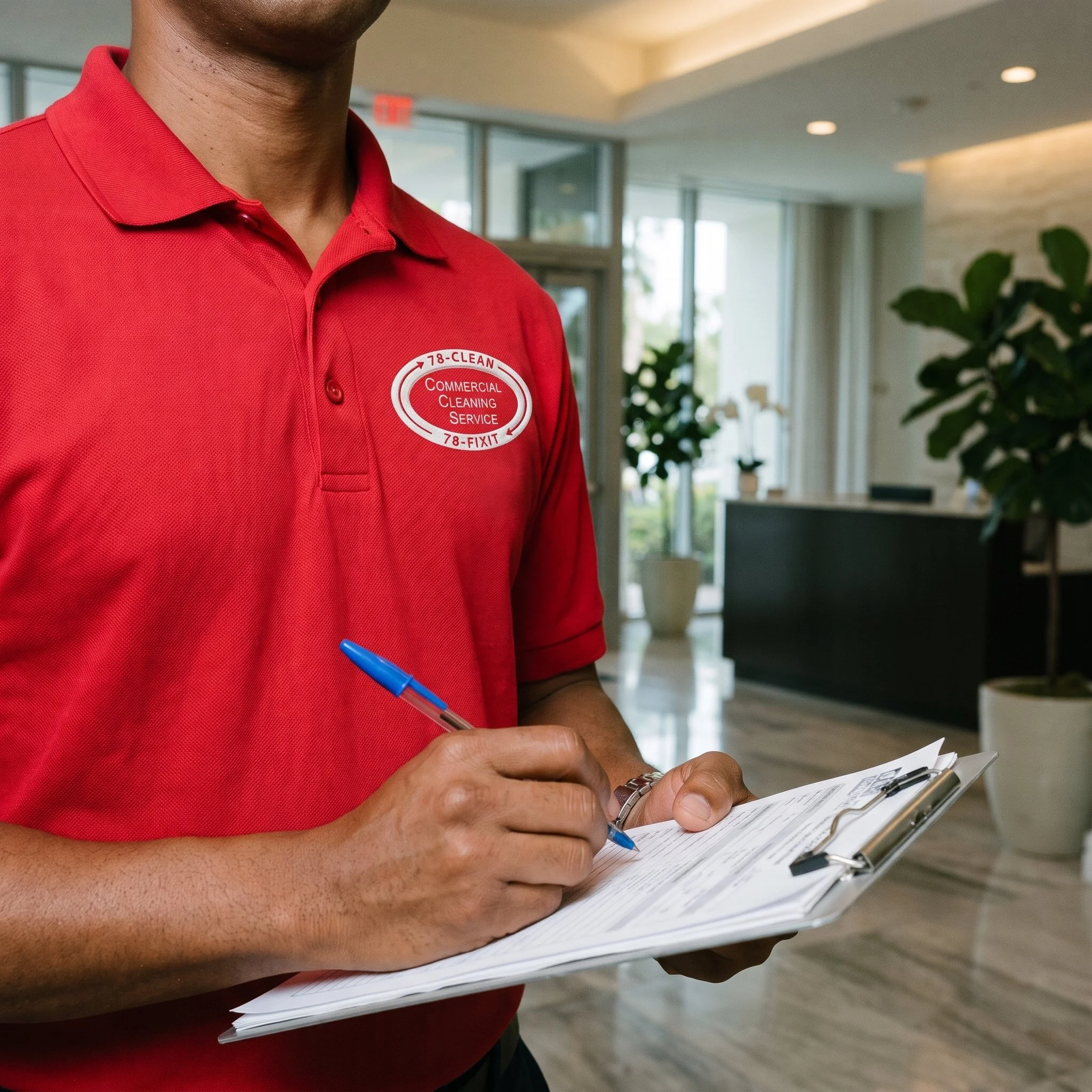
At Commercial Cleaning Service, every client has a dedicated Relationship Manager who knows their property, their history, and their expectations. They don't rotate. When you call, you're talking to someone who knows your building.
2. How do you handle quality control between visits?
Cleaning quality degrades quietly. A crew that started strong six months ago may have developed shortcuts that are hard to detect until a tenant says something or you notice it yourself during a walkthrough. The question isn't whether your vendor has quality standards — they all claim to. The question is how those standards are actually enforced after the contract is signed.
A good answer describes a concrete process: supervisor inspections on a defined frequency, a checklist or reporting system, and what happens when an inspection identifies a problem. "We trust our crews" and "our clients tell us if something's wrong" are not quality control programs.
At Commercial Cleaning Service, monthly supervisor inspections are built into every service program — not as an add-on or an escalation response, but as a standard part of how we keep quality consistent across every building we serve.
3. Are your employees trained, and what does that training look like?
Cleaning is a skilled trade. Salt extraction before carpet cleaning, not after. HEPA filtration for biohazard situations. The correct sequence for disinfecting high-touch surfaces. The difference between cleaning for appearance and cleaning for health. These aren't instincts — they're learned, and they require real training to do correctly.
A good answer describes a formal onboarding and training process, not just on-the-job learning. Bonus points if the vendor can speak to employee tenure and turnover — a crew with two years of experience in your building carries institutional knowledge that a new hire can't replicate.
Ask specifically: how long does a new crew member train before they're assigned to client buildings independently? The answer tells you a lot.
4. What happens when there's an emergency or something breaks down outside business hours?
A water-damaged ceiling after an overnight pipe issue. A broken entry lock at 10 PM on a Friday. A tenant reporting something in a common area that can't wait until Monday. These situations happen in managed buildings, and how your vendor responds to them tells you whether you have a partner or just a daytime service.
A good answer doesn't just promise responsiveness — it describes a specific process. Who do you call? What's the response time commitment? Is there a crew or a technician available, or are you waiting for a call back from someone who will then try to find someone?
78-Fixit, our maintenance and repair division, provides 24/7 emergency response for contracted clients. Our team responds with a master key and familiarity with the building — no waiting for a locksmith, no explaining your layout to someone who has never been there.
5. Can you provide a certificate of insurance, and what does your coverage include?
This one catches vendors off guard more often than it should. Every legitimate commercial cleaning vendor should be able to produce a certificate of insurance on request, naming your property as an additional insured. If they can't, or if there's significant delay or resistance, treat it as a serious red flag.
What to look for: general liability coverage (protects against property damage and bodily injury that occurs during service), workers' compensation (protects you if a crew member is injured on your property), and bonding (protects against theft by employees). Ask for the coverage limits and verify that they're adequate for the scope of work being done in your building.
A vendor who is properly insured and bonded will have this documentation ready. A vendor who isn't will have reasons why the question is unnecessary.
The pattern in the answers
Notice what good answers to all five questions have in common: they're specific. They name a person, describe a process, reference a frequency, or point to a document. Vague answers — "we take quality seriously," "our clients are always happy," "we're fully insured" — aren't answers. They're deflections.
The vendors worth working with are the ones who answer these questions confidently and specifically, because they've built systems that support those answers.
If you'd like to ask us these questions — and hear our specific answers for your property — we'd welcome the conversation.
Call 617-78-CLEAN or visit 78clean.com to schedule a walkthrough or request a proposal.