
When property managers evaluate commercial cleaning vendors, the conversation usually centers on price, scope, and references. What rarely comes up — but should — is employee turnover. How long do the vendor's crews stay? How often does the person cleaning your building change? What happens to your building when it does?
These questions don't show up on a proposal, but their answers have a direct impact on the quality and consistency of service your building actually receives. Here's why turnover is one of the most underappreciated factors in a commercial cleaning relationship — and what high-turnover operations cost you that never appears on an invoice.
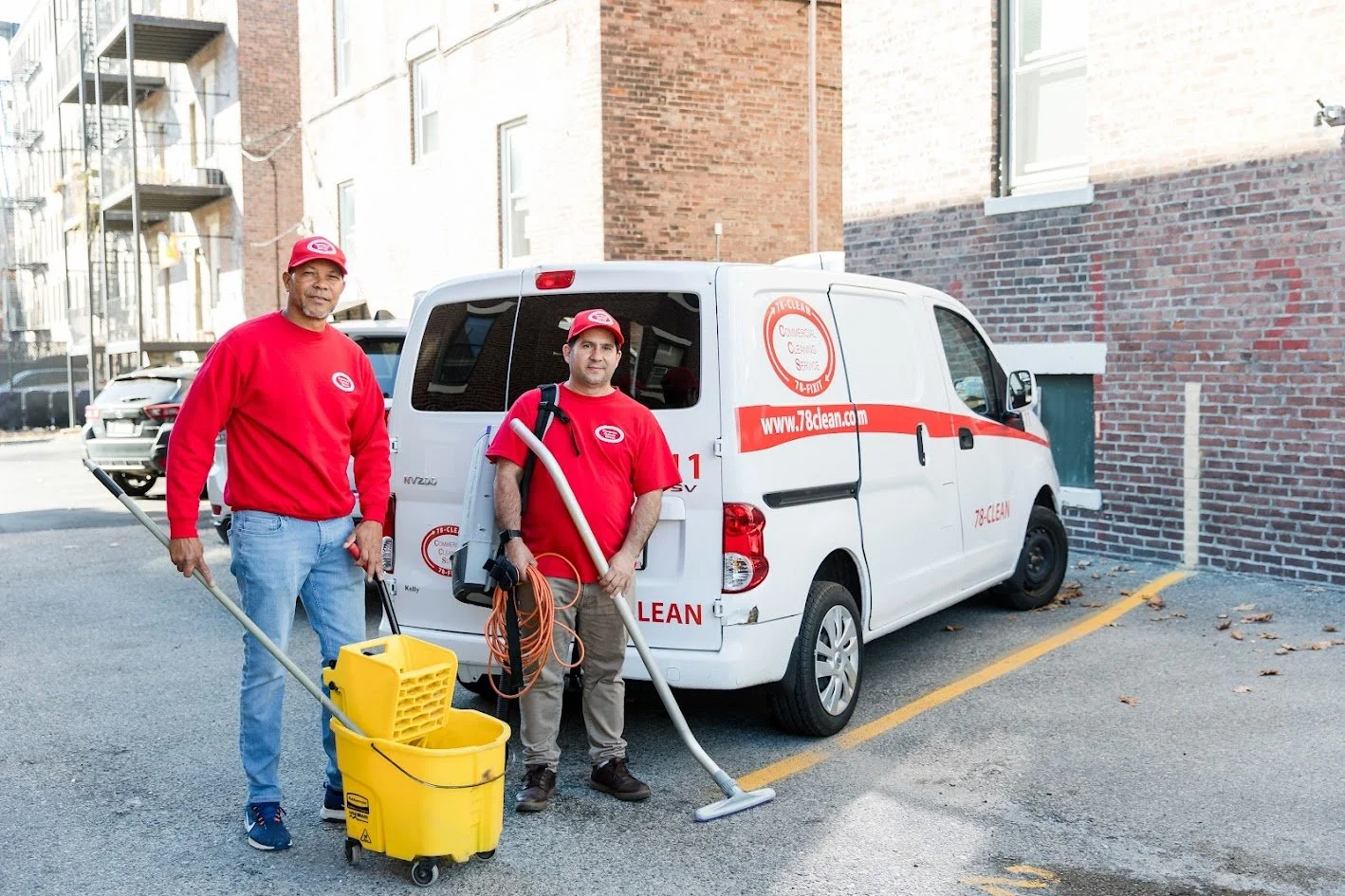
What a cleaning crew actually knows about your building
A crew member who has been servicing your building for two years knows things that can't be written in a checklist. They know which tenant has specific requests about their space. They know that the third-floor bathroom has a slow drain that needs extra attention. They know the quirks of the mechanical room, which doors are stiff, where supplies are stored, and what "clean" means for your property specifically.
That knowledge accumulates slowly, over dozens of visits, and it's invisible until it disappears. When a crew member is replaced — and in high-turnover operations, this happens constantly — that institutional knowledge walks out the door with them. The new person starts from scratch, working from a scope document that describes the building in general terms but can't capture what the previous crew member learned from experience.
The result isn't a building that looks dramatically different overnight. It's a building that's slightly less well-served, in ways that are hard to point to but easy to feel — until something is missed often enough that a tenant calls.
Why low-bid vendors tend to have high turnover
Cleaning is skilled, physical work. The people who do it well, consistently, over years, do so because they're fairly compensated, well-managed, and treated as professionals. Those conditions cost something. Vendors who compete primarily on price are often competing by reducing those costs — lower wages, thinner supervision, faster onboarding and faster replacement.
The result is a staffing model built around interchangeability: the assumption that any trained body can service any building, and that turnover is a staffing problem to manage rather than a service quality problem to prevent. This model works well enough for vendors who are selling on price. It works poorly for buildings that want consistent, knowledgeable service.
It's worth asking any vendor you're evaluating: what is your average employee tenure? What does your onboarding and training process look like? How do you handle the transition when a crew member leaves a building? The answers will tell you a great deal about how that vendor thinks about quality.
The retraining cycle and what it costs
Every time a crew member turns over, there's a retraining period — a window during which the new person is learning the building, making small errors, and providing service that is by definition less informed than the person they replaced. In high-turnover operations, some buildings are essentially always in this window.
The costs of that cycle are real, even if they're hard to quantify on a line item:
More supervision required from you. A new crew means more walkthroughs, more feedback, more of your time and your Relationship Manager's time catching things that an experienced crew would have caught themselves. The vendor's turnover becomes your management burden.
Increased risk of tenant complaints. The most common source of tenant complaints about cleaning isn't a single dramatic failure — it's accumulated small inconsistencies that build into frustration. A new crew is more likely to miss the things that matter to a specific tenant or space, because they haven't learned them yet.
Slower problem identification. An experienced crew notices when something changes in a building — a new leak, a fixture starting to fail, a maintenance issue developing. A new crew is focused on learning the cleaning scope, not on the building's condition relative to what it was last month. The proactive observation that experienced crews provide disappears with them.
What low turnover actually looks like in practice
A vendor with genuinely low employee turnover has built conditions where people want to stay: fair compensation, real training, clear standards, and management that treats the work as skilled rather than fungible. That's not an accident — it's a deliberate operational choice that shows up in service quality over time.
For the buildings those crews serve, the effect compounds. A crew member in year three knows your building the way a good building superintendent does — not from a document, but from sustained attention. They notice things. They flag things. They take ownership in a way that a rotating cast of newer employees simply can't.
At Commercial Cleaning Service, we invest in formal training and in keeping our people. Many of our crew members have been with us for years — some for over a decade — and that continuity is one of the things that most distinguishes the service our long-term clients receive from what they had before. It's also one of the things that's hardest to demonstrate on a proposal, which is why we'd rather show you than tell you.
The question to ask
Before signing with any cleaning vendor, ask for their average employee tenure and their annual turnover rate. If they can't answer, or won't, that's information. If the number is high, ask how they manage the building transition when crew members leave.
You're not just buying a cleaning scope. You're entering a relationship with the people who will be in your building, week after week. The stability of that workforce is one of the most important — and least discussed — factors in whether that relationship works.
Call 617-78-CLEAN or visit 78clean.com to talk about what a stable, trained team means for your building.